What Is Turn Pressure and Ascent Pressure in Technical Diving?
The turn point isn't a feeling or a flat fraction of your gas - it's two specific numbers you can calculate before you're ever in the water.
Turn Pressure is the cylinder pressure at which a dive should turn around so that, after burning gas on the way back to the ascent line or exit, the diver still arrives with at least Ascent Pressure - the minimum pressure needed to reach the next gas switch while keeping tank pressure above reserve. Together, they answer the two questions every OC diver needs answered before penetrating a wreck, cave, or simply swimming away from the anchor line: "when do I turn?" and "what should I have left when I get back?"
Why the rule of thirds falls short
The classic manual method is the rule of thirds: use a third of your starting gas going in, a third coming out, and keep a third in reserve. It's simple, memorable, and taught for a reason - it works as a baseline when you have nothing better. But it's a fixed fraction, and a real dive isn't fixed. A long, shallow swim out and a short, deep swim back consume gas at different rates. A current that helps you out and fights you on the way back changes the math. Team size, gas-sharing contingencies, and tank configuration all change how much gas actually needs to be in reserve.
Turn Pressure and Ascent Pressure replace the flat fraction with numbers computed from the dive you're actually planning: your SAC rate, your tank size, the distance and depth profile, and the reserve you've set. Depending on the dive, that can turn out more conservative than a third - or less.
Turn Pressure, defined
Turn Pressure is the pressure at which the dive should be turned so that, by the time you're back at the ascent line, your remaining gas equals Ascent Pressure. It's calculated backward from the exit: start with Ascent Pressure, add back the gas you'll burn covering the return to the line based on time, depth and SAC rate, and that total is the number on your gauge that means "turn now."
Ascent Pressure, defined
Ascent Pressure is the floor, not the trigger. It's the minimum pressure you need when you reach the ascent line (or exit) to get through the next gas switch while keeping your tank pressure above the reserve you've set. Turn Pressure is built around hitting this number, not below it, when you arrive back at the line.
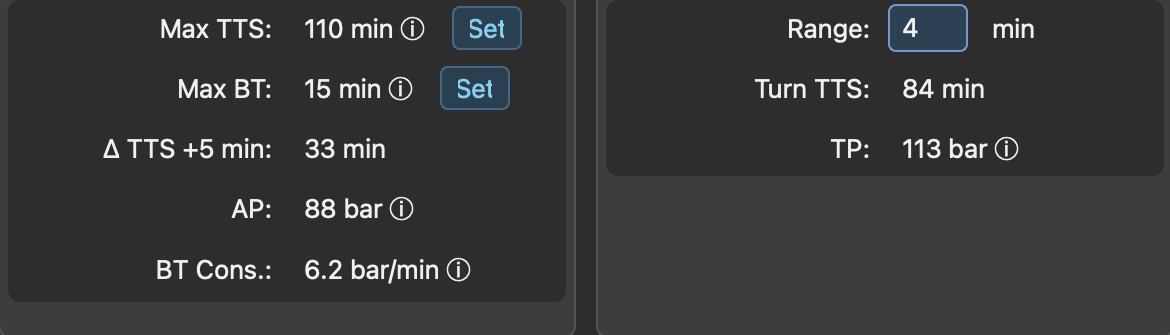
DiveCast's front page for an OC dive, with Turn Pressure and Ascent Pressure calculated alongside Turn TTS.
Turn TTS: the time-based version for CCR
On a closed-circuit rebreather, gas consumption is largely irrelevant, so pressure isn't the natural trigger. What matters instead is time: Turn TTS (time-to-surface) is the CCR equivalent of a turn point, marking at which TTS reading on your dive computer you should turn around, and hit your target TTS (and therefore your plan for deco obligations) at the line or exit. It plays the same role Turn Pressure plays on OC - a computed "turn now" signal - just expressed in minutes instead of bar.
Say you plan a dive where your return to the line will take 4 min; the depth is 50 m and you have calculated your Ascent Pressure at 100 bar (what you want left when you reach the line); your SAC rate is 16 L/min, your tanks are double S80s (11.1 L each). Gas burned on the way back is roughly 16 L/min × 4 min × 6 bar ÷ (2 × 11.1 L) = 17.3 bar, rounded to 20 bar. Turn Pressure would then be about 100 + 20 = 120 bar - the number on your gauge that means "stop going in, start heading back."
DiveCast calculates this for every plan
Turn Pressure, Ascent Pressure, and Turn TTS for both OC and CC are solved from the actual plan you build - depth, distance, SAC, gas - and shown right on the dive's front page, recalculated the moment anything changes.
See it on the homepage →Frequently asked
Is turn pressure the same as the rule of thirds?
No. The rule of thirds is a fixed fraction that ignores the specifics of a given dive. Turn Pressure is calculated from the actual depth, distance, and consumption rate for that dive, so it can land more conservative or less conservative than a flat third.
Does Turn Pressure apply to CCR diving?
The pressure-based version applies most directly to open circuit, where cylinder pressure is the limiting resource. On CCR, Turn TTS plays the equivalent role, using time-to-surface instead of pressure as the trigger.
What's the difference between Ascent Pressure and reserve pressure?
Reserve pressure is a floor you never want to go below at any point in the dive. Ascent Pressure is the specific amount you're planning to have in hand when you reach the ascent line or exit so that you will be left with the reserve at your next gas switch.