OC vs. CCR Dive Planning: What Actually Changes
Same depth, same decompression theory underneath - but the numbers that actually drive the plan shift in specific, predictable ways.
Open circuit (OC) and closed-circuit rebreather (CCR) diving run on the same underlying decompression theory, but planning one is not simply planning the other with different numbers plugged in. The core difference: on OC, every breath vents to the water; gas consumption scales directly with depth and time; and gas partial pressures vary with depth and gas switch. On CCR, exhaled gas is scrubbed of CO2 and recirculated, with oxygen added to maintain a target partial pressure - so loop gas consumption is small and largely independent of depth; and inhaled gas is constantly mixed to achieve a constant target of ppO2. Think about a CCR as your own mixing station carried all along your dive, giving you the perfect gas for the depth you are at.
What changes: the gas math
On OC, "how much gas do I need" is the central planning question, solved directly from depth, time, and SAC rate. On CCR, that same question mostly disappears for the loop itself - diluent gas is used for loop volume changes and to lower ppO2 when required. The gas-math question that replaces it is arguably more consequential: "how much open-circuit bailout gas do I need if the loop fails," which is planned exactly like an OC diver's primary gas would be for the same depth and time.
What changes: setpoint management
CCR planning adds a variable that has no OC equivalent: oxygen setpoint, the target partial pressure of oxygen the rebreather's electronics or the diver maintain by injecting O2 into the loop. A dive can run a constant setpoint throughout, or a depth-indexed schedule that changes setpoint at planned depths - each choice changes CNS oxygen exposure, decompression obligation, and how the dive should be flown, in ways an OC diver planning fixed gas switches doesn't have to think about at all.
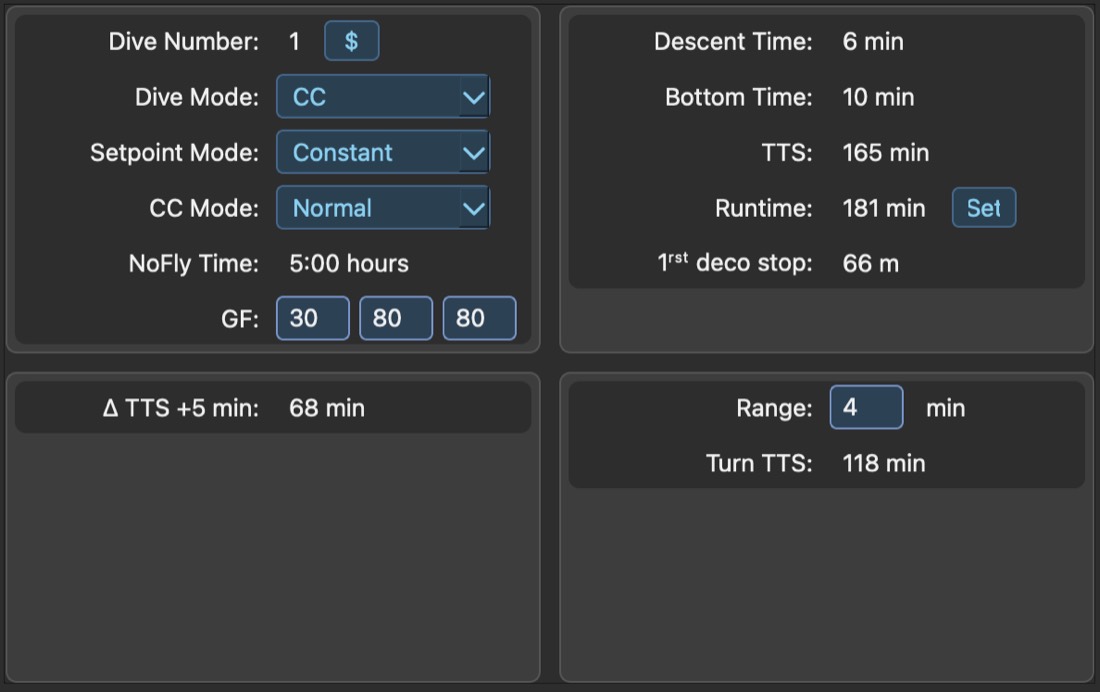
DiveCast's CC parameters panel: setpoint mode and gradient factors sit alongside the same TTS and runtime fields an OC plan uses.
What changes: the turn-point trigger
On OC, the natural turn-point trigger is pressure - Turn Pressure, calculated so the diver arrives back at the ascent line with Ascent Pressure remaining (see the companion guide on turn points). On CCR, pressure isn't the limiting resource in the same way, so the trigger shifts to time: Turn TTS marks how long the trip back and up would take if the dive turned right now, playing the same functional role in minutes instead of bar.
What stays the same
- The decompression algorithm - gradient factors and tissue-loading theory work the same way underneath, regardless of how the inspired gas is delivered.
- Contingency thinking - both disciplines plan for the worst point of the dive, not just the average one.
- The need for real numbers over rules of thumb - "a third of my gas" or "whatever setpoint feels right" are starting points, not plans.
One planner, both disciplines
DiveCast plans OC and CCR dives - including CCR bailout, run entirely on open-circuit gas math - inside the same tool, so switching between them isn't a separate spreadsheet or a separate mental model.
See it on the homepage →Frequently asked
Does a CCR diver ever need to think about SAC rate?
Yes - for diluent use and, especially, for bailout gas planning, where OC-style SAC-rate math applies directly.
Is CNS exposure calculated differently on CCR?
The underlying oxygen-toxicity tracking is the same, but a CCR dive run near a constant, elevated setpoint for a long bottom time can accumulate CNS exposure differently than an OC dive using a lower, fixed-mix partial pressure of oxygen for the same duration.
Can the same dive plan be viewed as both OC and CCR?
The two need separate gas and setpoint models to be planned correctly, but there's real value in planning both for the same target depth and time, specifically to compare how the numbers diverge.