Why Your Real SAC Rate Under Stress Is Higher Than You Think
A calm-water SAC rate is a baseline, not a guarantee - here's what actually happens to gas consumption when a dive goes sideways.
Your Surface Air Consumption (SAC) rate measured on an easy, calm dive is a genuinely useful number - but it's a floor, not a plan. The moment a dive adds cold, current, task loading, or an actual emergency, respiratory rate and effort climb, and so does gas consumption. Planning an entire dive - including its contingencies - around a single calm-water SAC rate quietly overstates how much margin you actually have exactly when you need it most.
What actually drives consumption up
- Stress and anxiety - a faster, shallower breathing pattern under psychological stress increases respiratory minute volume even without added physical work.
- Cold - cold water increases the physical work of breathing and raises overall metabolic demand, both of which increase gas use.
- Exertion and task loading - swimming against current, managing a problem, or assisting a buddy all add physical workload on top of the baseline.
- Depth - depth magnifies the actual consumption calculated using a surface SAC rate multiplied by the ambient pressure.
- Gas density - the deeper the dive, the higher the gas density. Gas density is a critical factor in hypercapnia, leading to a feeling of being out of breath and a spike in SAC rate.
None of this is a reason to abandon a measured baseline SAC rate - it's the right starting point. The point is that bottom-time limits, bailout gas, and reserve calculations built only on that baseline are answering "how much gas do I need on an easy day," not "how much gas do I need if this dive goes wrong."
Scenario-based planning: a range instead of one number
Rather than picking a single "stressed" multiplier out of the air, it's more useful to plan a small range of named scenarios - each scaling SAC rate (and, realistically, ascent rate) by a different amount - and see how each one changes the plan's gas math. That turns "what if things get harder" from a vague worry into a specific, comparable set of numbers.
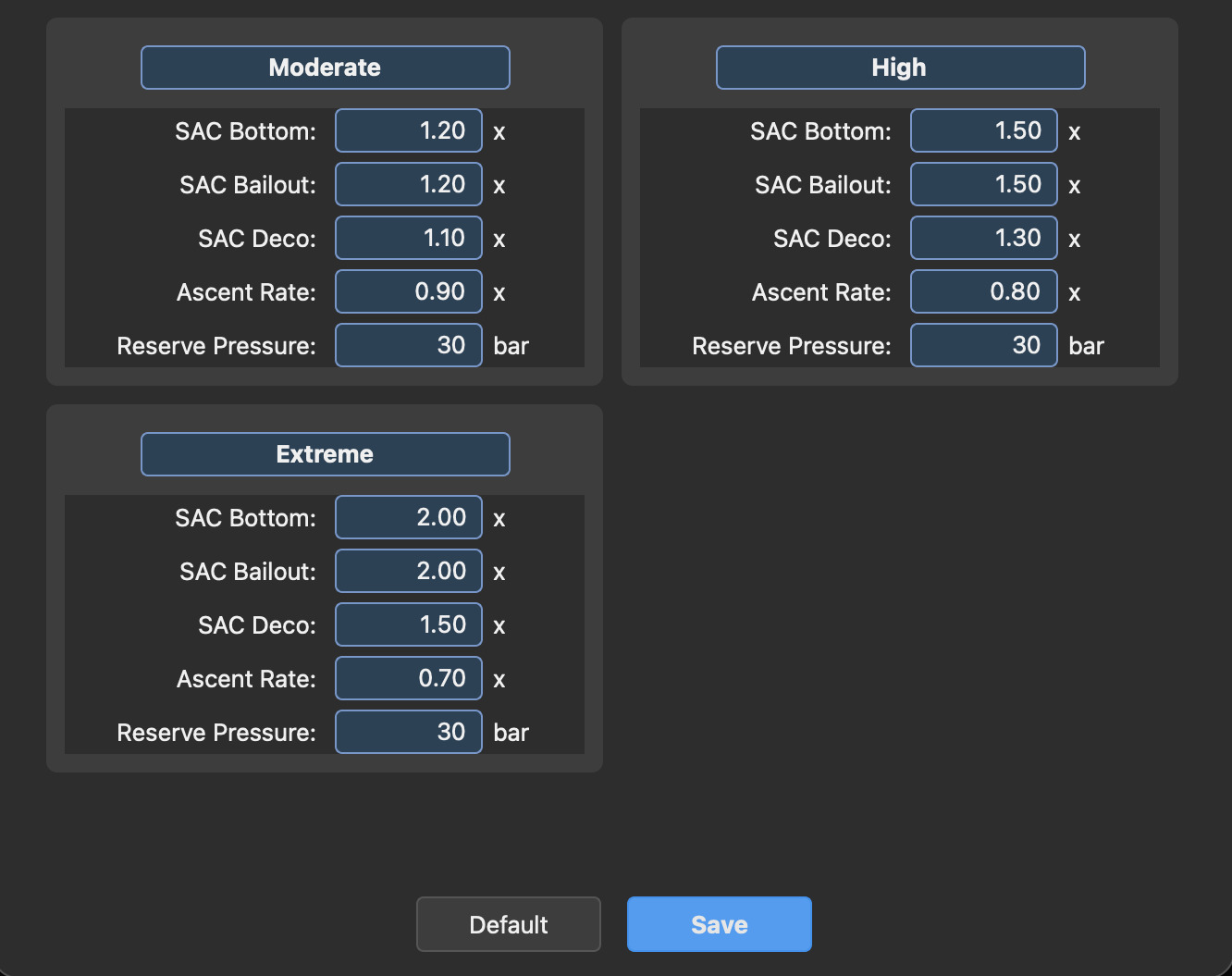
DiveCast's Moderate / High / Extreme scenario definitions - separate multipliers for SAC bottom, SAC bailout, SAC deco, ascent rate, and reserve pressure.
A Moderate scenario might scale SAC bottom and SAC bailout by roughly 1.2× and slow ascent rate to around 0.9× of base values. A High scenario might push SAC by roughly 1.5× with ascent rate down to about 0.8×. An Extreme scenario - a genuine emergency - might double SAC consumption (2.0×) while ascent slows further, to around 0.7×. Run the same dive plan through all three and you can see, in bar and minutes, exactly where a calm-water plan stops having enough margin.
Applied to a real gas plan, the effect is immediate and sometimes uncomfortable: a gas configuration with a comfortable reserve at your normal SAC rate can show a negative reserve - literally not enough gas - the moment a Moderate or High stress multiplier is applied to the same profile.
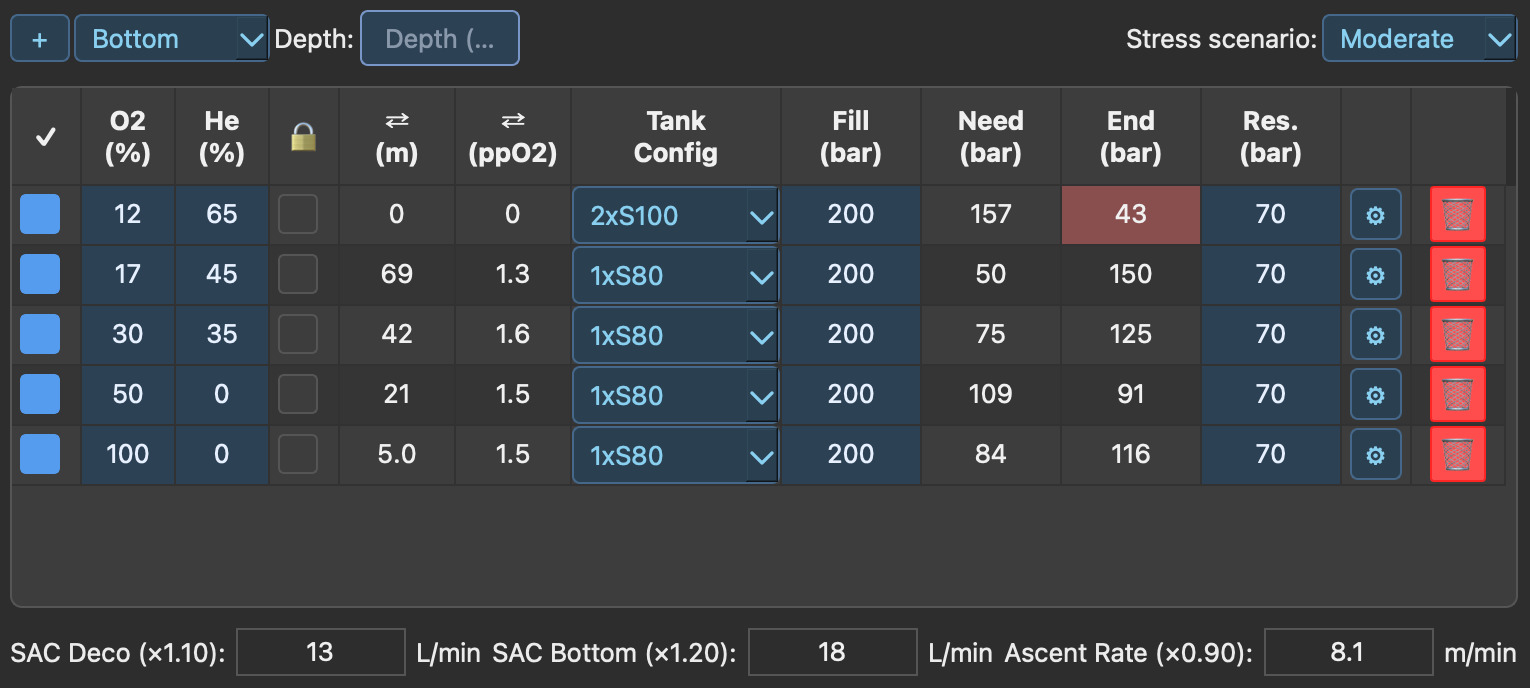
Same gas plan, Moderate scenario applied: end pressure on one gas drops below reserve and is flagged immediately.
One dropdown. A completely different gas plan.
Pick Moderate, High or Extreme and DiveCast recalculates every gas's need, end and reserve pressure instantly - flagging the moment one runs short, instead of finding out in the water.
See it on the homepage →Frequently asked
Should I just always plan gas using my worst-case SAC rate?
Always planning for the worst case tends to produce overly conservative bottom times for the vast majority of normal dives. Scenario-based planning lets you see the base plan and the stressed plan side by side, and discuss with your team the appropriate strategy.
Does a stress scenario also affect deco gas consumption?
It should - a real stress event doesn't stop being stressful the moment you start decompressing, so SAC deco is worth scaling alongside SAC bottom and SAC bailout, typically by a smaller multiplier than an acute bottom-phase stressor.
Is a slower ascent rate under stress realistic?
Yes - a stressed or task-loaded diver rarely maintains the same controlled ascent rate as a calm one, which is why realistic scenarios reduce ascent rate alongside raising SAC rate. A slower ascent is more conservative as it increases the time to the next switch and therefore planned gas consumption.