How to Plan CCR Bailout Gas
A worked example of solving backward from "how much gas am I carrying" to "how long can I actually survive a loop failure."
Bailout gas is the open-circuit gas a closed-circuit rebreather diver carries specifically for the moment the loop can't be trusted anymore - a flood, a CO2 scrubber failure, an O2 sensor problem - and the dive has to finish on OC. Planning it well means answering one question with real numbers: if I bail out right now, at the worst point of this dive, does what I'm carrying actually get me to the surface?
What is the worst point of the dive for a failure
It will be when you have the longest path to your first gas switch. If you can free ascend at any point of your dive, the worst point will be at the end of your bottom time, where you will have built up the maximum deco obligations and therefore the longest time to get to your first gas switch. If you are in an overhead environment, it will be when you have the maximum distance to return to the exit: you will be at maximum depth, and your gas consumption on OC will be highest. This return to the exit is a critical component of estimating how much bailout gas to carry.
The two numbers that matter: Max TTS and Max BT
Max TTS (maximum time-to-surface) is the longest ascent-plus-decompression time your carried bailout gas can cover, at your planning bailout SAC rate. Max BT (maximum bottom time) is the flip side of the same calculation - given your bailout gas and Max TTS, how long can you stay at the bottom before you'd no longer be able to get back with an OC bailout in hand? Both are solved backward from the gas you're actually carrying, not assumed from experience on a different dive.
Why this is a "solve backward" problem
You already know how much bailout gas you're carrying - it's fixed by your cylinder configuration - so the question becomes: given that gas, how far into the dive can you go before a worst-case bailout would run you under your reserve? That's a backward calculation from available gas to allowable bottom time, using your bailout SAC rate (which should be higher than your normal working SAC rate - see the companion guide on stress rates) and the ascent/deco profile a bailout at that point would actually require. DiveCast calculates your Max TTS and Turn TTS for you, from your configuration, dive profile and SAC rates, to make sure a bailout leaves you with your reserve intact.
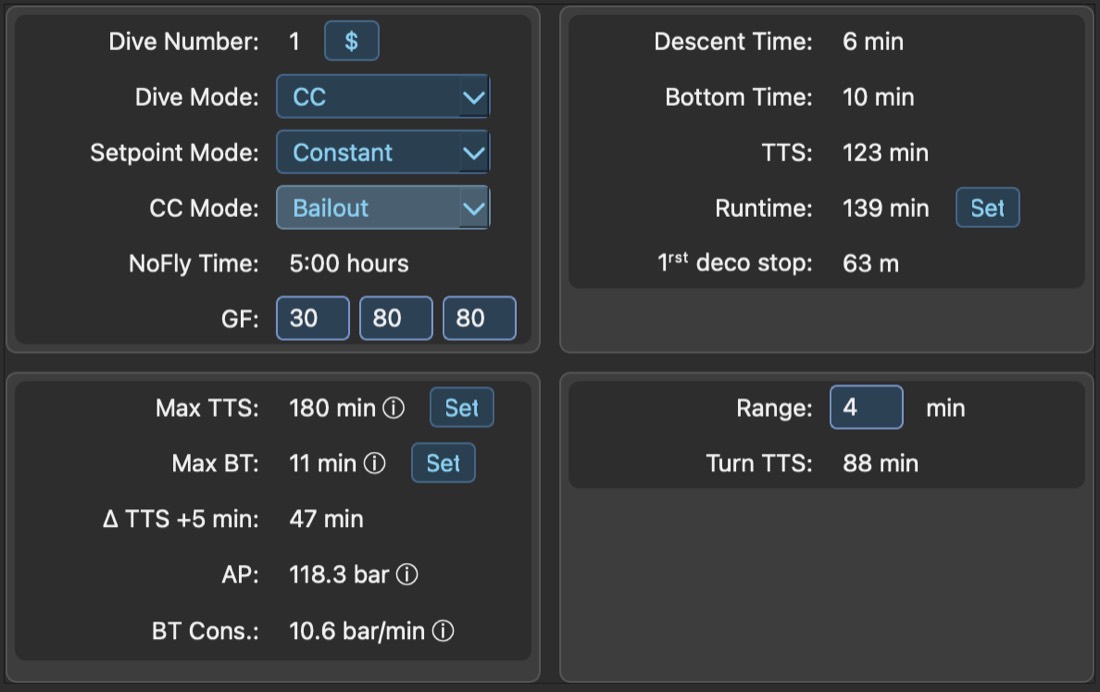
DiveCast's CC parameters panel switched to Bailout mode: Max TTS and Max BT recalculated instantly against open-circuit gas math.
Say you're carrying two 80 cubic-foot (S80) bailout cylinders, filled to 200 bar, with 70 bar reserved as a hard floor - leaving roughly 130 bar of usable pressure per cylinder for bailout. At 65 m, ambient pressure is about 7.5 bar, and at a bailout SAC rate of 25 L/min (typically elevated compared to your base rate, since you most likely bailed out due to an issue with your rebreather, possibly leading to hypercapnia), you'd burn roughly 7.5 × 25 = 188 L/min at the bottom - almost 9 bar a minute across your dual tanks. That single number already tells you a lot about how few minutes of bottom time a two-cylinder bailout actually buys you at that depth - before any deco obligation is added on top. This is exactly the kind of multi-variable, depth-and-time-dependent math worth automating rather than approximating on a slate.
What actually shifts the numbers
- Depth - gas consumption scales with ambient pressure, so the same SAC rate costs far more cylinder volume at 65 m than at 20 m.
- Bailout SAC rate - a real emergency is not a baseline; plan bailout consumption significantly higher than your normal working rate.
- Deco obligation - a bailout late in a long, deep dive doesn't just need ascent gas, it needs to carry you on OC until your first gas switch.
- Tank configuration - cylinder count and size set the hard ceiling everything else is solved against.
DiveCast solves this automatically
Switch CC mode from Normal to Bailout and DiveCast recalculates Max TTS, Max Bottom Time, and your first deco stop against real open-circuit gas math - instantly, from the gas you've actually configured. You immediately see your gas consumption and gas remaining for each tank configuration you carry, and you can run different stress scenarios with a click to stress-test your bailout plan.
See it on the homepage →Frequently asked
Should bailout SAC rate be higher than my normal SAC rate?
Yes - a real bailout is a stress event, and consumption under stress is reliably higher than calm, working consumption. Planning bailout gas at your normal SAC rate tends to overstate how much margin you actually have.
Does Max BT already include the deco obligation?
Yes - Max BT is only meaningful if it accounts for the full ascent and any stops that bailing out at that point in the dive would require, not just the swim back to the exit.
Is bailout gas planning different for OC divers?
Bailout planning is planning an OC dive from a point where you've already on-gassed during the pre-bailout period, so you start already carrying deco obligations.