SMB Deployment Timing: How Far Can You Actually Drift?
Deploy too early and you spend unnecessary time at depth, where deco obligations climb quickly and gas consumption is highest due to higher ambient pressure. Deploy too late and the boat may not find you. Here's how to calculate the window in between.
A surface marker buoy (SMB) tells the boat where you are before you're actually on the surface - which only works if it goes up while you're still close enough to where the boat expects you. Deploy it too early and your deco obligations and gas consumption increase unnecessarily due to depth and ambient pressure. Deploy it too late and, having drifted too far, the SMB won't be visible from the boat. The right moment is a specific, calculable point, not a habit.
The two inputs that set the window
- Acceptable drift distance - how far from your planned exit point (or the boat) you're willing for the SMB to surface and still be visible from the boat.
- Current speed - how fast the water is moving you horizontally while you ascend and decompress.
Given those two numbers, and when you deploy in your ascent / deco, you can work out exactly how far the SMB will have drifted from your position at the end of the bottom phase of your dive - and therefore find the latest point in the ascent where that distance still stays within what you've decided is acceptable. It is useful to know at what depth you will be, as it will be much easier to remember or write down on your slate.
Why "latest safe point" matters more than "as early as possible"
It's tempting to think deploying early is always safer, but deploying an SMB takes time, requires you to stay stationary, and could quickly turn into an entanglement hazard if not executed properly - all things you'd rather do as shallow as possible to limit on-gassing and gas consumption. The latest point that still keeps you inside your acceptable drift is the point that minimizes risks while keeping the surfacing SMB within sight of your surface cover.
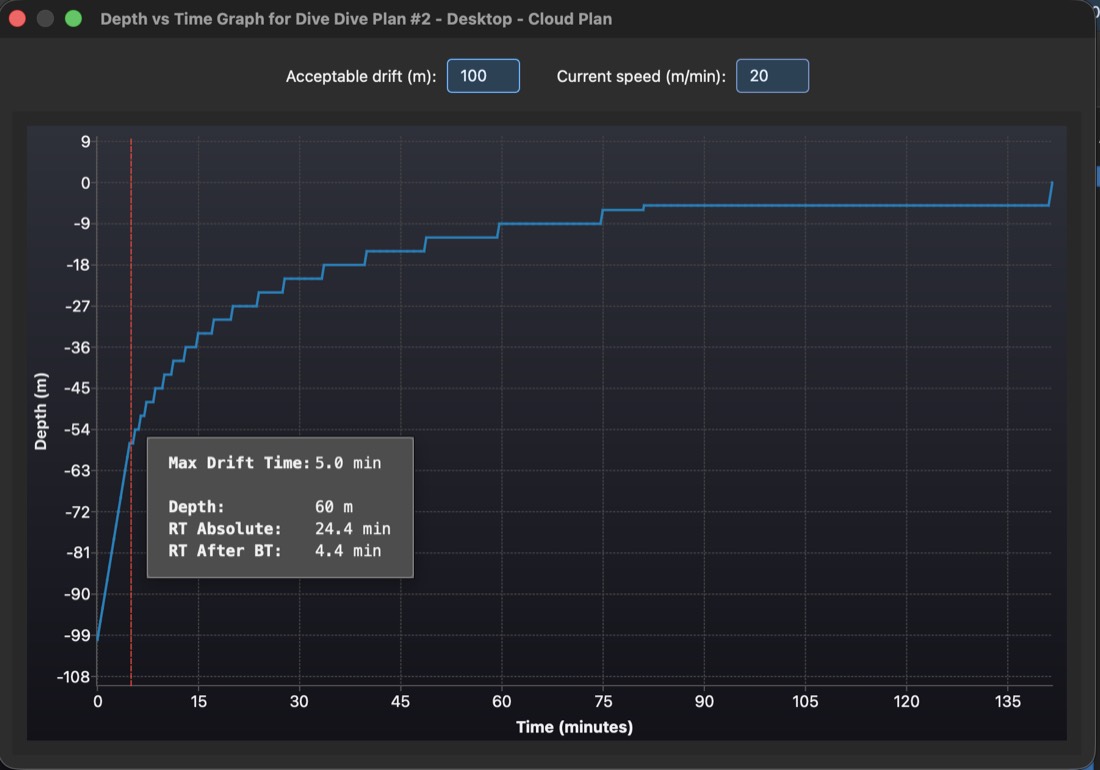
DiveCast marks the latest safe SMB deployment point directly on the ascent profile - depth and time.
Say you've set an acceptable drift of 100 m and current speed is 20 m/min. That means you can tolerate roughly 5.0 minutes of ascent / deco time from the point you left the bottom. Working backward through the ascent profile, the point where exactly 5.0 minutes of ascent has passed is your deployment point. On a real profile that might land at 60 m; on a different profile it might be another depth.
Know exactly when to deploy
Set your acceptable drift and current speed, and DiveCast marks the latest point on your ascent - depth and time - where deploying still keeps you inside that range, worked out from the actual profile you planned.
See it on the homepage →Frequently asked
Is there a standard acceptable drift distance?
No - it depends on the site, boat cover, sea state, and team protocol. It's a value your team sets deliberately, not a fixed industry number.
What if current speed changes during the dive?
A single planning estimate won't capture real variation, so it's worth building in margin and, where possible, using the most conservative reasonable current estimate for the ascent phase specifically.
Does a deeper deployment point mean more conservative, since there's less drift?
No. Deploying an SMB takes time, requires you to stay level, and carries an inherent risk of entanglement for you or your buddies if not executed properly. Sorting out these situations at greater depth brings more risk - elevated gas consumption and more deco obligation - which in turn brings more risk.