Gradient Factors Explained: GF Low vs. GF High
Two numbers that shape every decompression stop in your plan - what they mean, and why one pair rarely fits every dive.
GF Low and GF High are two percentages that add a personal safety margin on top of a Bühlmann-style decompression algorithm. GF Low controls how conservative your first, deepest stop is; GF High controls how conservative your final stop is; DiveCast adds a 3rd GF to allow you to set the GF at which you will surface independently from GF High (GF Surfacing). Most dive computers assume GF Surfacing equals GF High, but you can optimize your parameters as you see fit. Set them lower and the algorithm keeps you further from its theoretical limits throughout the ascent; set them higher and you get closer to those limits, with shorter deco.
Where gradient factors come from
Underneath, most modern technical dive planning runs on a Bühlmann ZHL-16 style algorithm, which tracks theoretical inert gas loading in a set of tissue compartments and defines an "M-value" - the maximum tolerated supersaturation - for each one at each depth. Run the algorithm at 100% of M-value and you get the shortest possible deco schedule, with zero margin for error, physiology you can't measure, or a bad day. Gradient factors were introduced as a practical fix: instead of allowing tissues all the way to 100% of M-value, you cap them at a chosen percentage - the "gradient factor." The low gradient factor is also an empirical way to reconcile the Bühlmann theory with the bubble theory: the lower the low GF is, the deeper the first deco stop will be, which according to the bubble theory reduces the risk of bubble formation.
GF Low: shapes the deep stops
GF Low is the ceiling applied at your first stop - the deepest point of your ascent schedule. A lower GF Low (say 20-30%) keeps you further from the theoretical limit early, which typically produces a deeper first stop and spreads deco time out earlier in the ascent. A higher GF Low lets you ascend closer to the naive Bühlmann ceiling before stopping at all.
GF High: shapes the shallow stops and surfacing
GF High is the ceiling applied as you approach the surface. A lower GF High means you surface with more theoretical margin left in your fastest tissues; a higher GF High shortens the shallow stops but leaves less of that margin. Because GF High governs the end of the dive, it has an outsized effect on total runtime compared to GF Low.
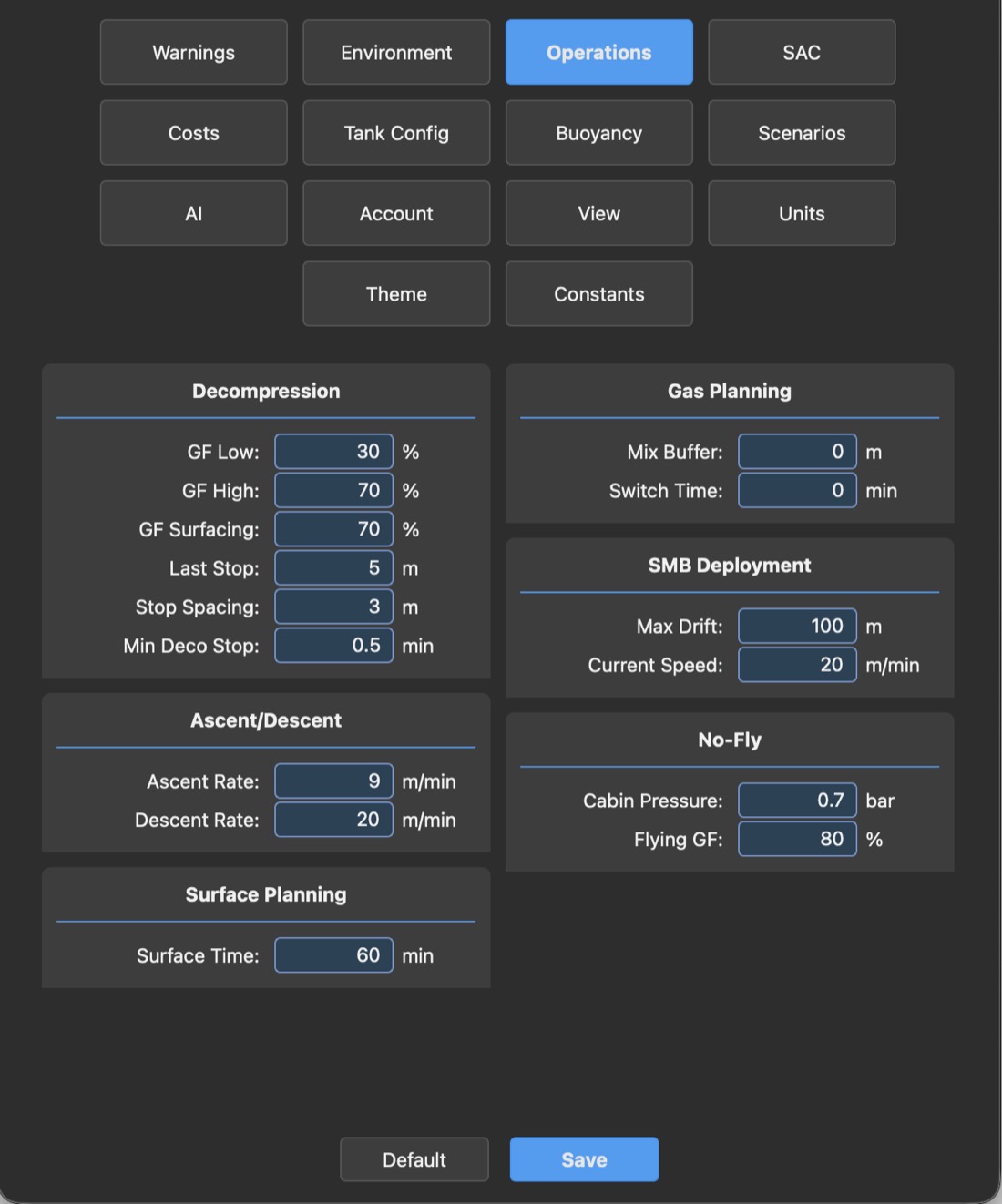
DiveCast's Decompression settings panel - gradient factors are fully exposed, not hidden behind a single conservatism slider.
Why DiveCast also exposes GF Surfacing
Most planners stop at GF Low/GF High. DiveCast adds a third, independent value - GF Surfacing - because "the ascent to your last stop" and "the swim from your last stop to the surface" aren't always numbers you want tied together. Separating GF High (which governs the shallow deco schedule) from GF Surfacing (which specifically governs the final ascent) gives you a way to, for example, run a slightly more aggressive shallow schedule while still keeping extra margin on the very last leg to the surface - without one setting quietly overriding the other. The last few meters from your last stop are where the relative changes in ambient pressure (and therefore in gas volumes) are the highest, and it's hard to overstate how carefully those last meters deserve to be treated.
Picking numbers isn't the point of this article
Common pairs like 30/70 or 40/80 show up constantly in training materials and forum threads, and DiveCast's own defaults reflect one such pair. But gradient factors are a personal choice shaped by training, experience, fitness, cold exposure, and the specific dive - not a universal constant to copy. If you're not already comfortable choosing your own GF values, that's a conversation for your instructor, not a default to inherit from someone else's settings screen.
Every constant, in your hands
DiveCast exposes GF Low, GF High, and GF Surfacing as separate, editable values - along with ascent/descent rates, stop spacing, and every other constant that shapes your schedule - saved to your profile, not buried behind a slider.
See Total Control on the homepage →Frequently asked
What's a "safe" gradient factor pair?
There isn't a universally safe pair - it depends on training, experience, fitness, and the dive itself. Treat any specific numbers you read online as examples, not recommendations, and get proper training before setting your own. Listen to your body after diving, and adjust your GF accordingly if fatigue sets in.
Does a lower GF High always mean a longer dive?
Generally yes - lowering GF High keeps more theoretical margin at the shallow end, which typically adds shallow stop time and extends total runtime.
Is GF Surfacing the same as GF High?
Not in DiveCast. GF High governs the shallow decompression schedule to the last deco stop; GF Surfacing is a separate value specifically for the final ascent leg to the surface, so the two can be tuned independently.