Why Your No-Fly Time Isn't the 12/18/24-Hour Rule
Agency guidelines are simple and conservative on purpose. Here's what a no-fly time calculated from your actual tissue loading looks like instead - and why it comes out shorter.
No-fly time is the surface interval you need before flying, so that the nitrogen still dissolved in your tissues after diving drops to a safe level at cabin altitude - not sea level. It's driven by three things: how much nitrogen you're still carrying, how fast your body eliminates it, and how low the cabin pressure on your flight will actually go.
Why cabin pressure is the real variable
After a dive, your tissues hold elevated nitrogen that's perfectly safe at 1 atmosphere, sea-level pressure. A pressurized aircraft cabin doesn't hold sea-level pressure - it's typically maintained around 6,000-8,000 feet of equivalent altitude, which is lower ambient pressure than you surfaced into. The same tissue loading that was safe on the boat can become unsafe at that reduced cabin pressure, which is exactly the mechanism no-fly time is protecting against: enough surface time for your tissues to off-gas until they're safe at cabin altitude, not just "back to normal."
Why calculated times come out shorter than 12-24 hours
DAN's widely-taught guidelines - roughly 12 hours minimum after a single no-decompression dive, 18 hours after multiple dives or multiple days of diving, and more than 18 hours after any decompression dive - are deliberately simple and conservative. They're built to be easy to remember and communicate, to cover worst-case profiles, and to include a liability-driven safety margin, without knowing your actual dive.
A calculated no-fly time works differently: it starts from your real tissue loading at the end of your actual dive, simulates ascent to a cabin-altitude pressure, and finds the surface time needed to be safe at that pressure - still with real safety margins built in (a safe gradient factor for the calculation itself, and a conservative/low cabin-pressure assumption below the regulatory maximum). The literature on this is consistent: physics-based calculations routinely come out shorter than agency rules of thumb, and that gap is expected, not a sign either approach is wrong. Agencies are optimizing for simplicity and worst-case coverage; a calculation is optimizing for precision on your specific dive.
Reading the decay curve
Nitrogen elimination isn't instant or linear - it's a decay curve, and what you breathe on the surface changes its shape. Breathing oxygen after a dive measurably accelerates nitrogen off-gassing compared to breathing air, which is why it's worth seeing both curves rather than a single number.
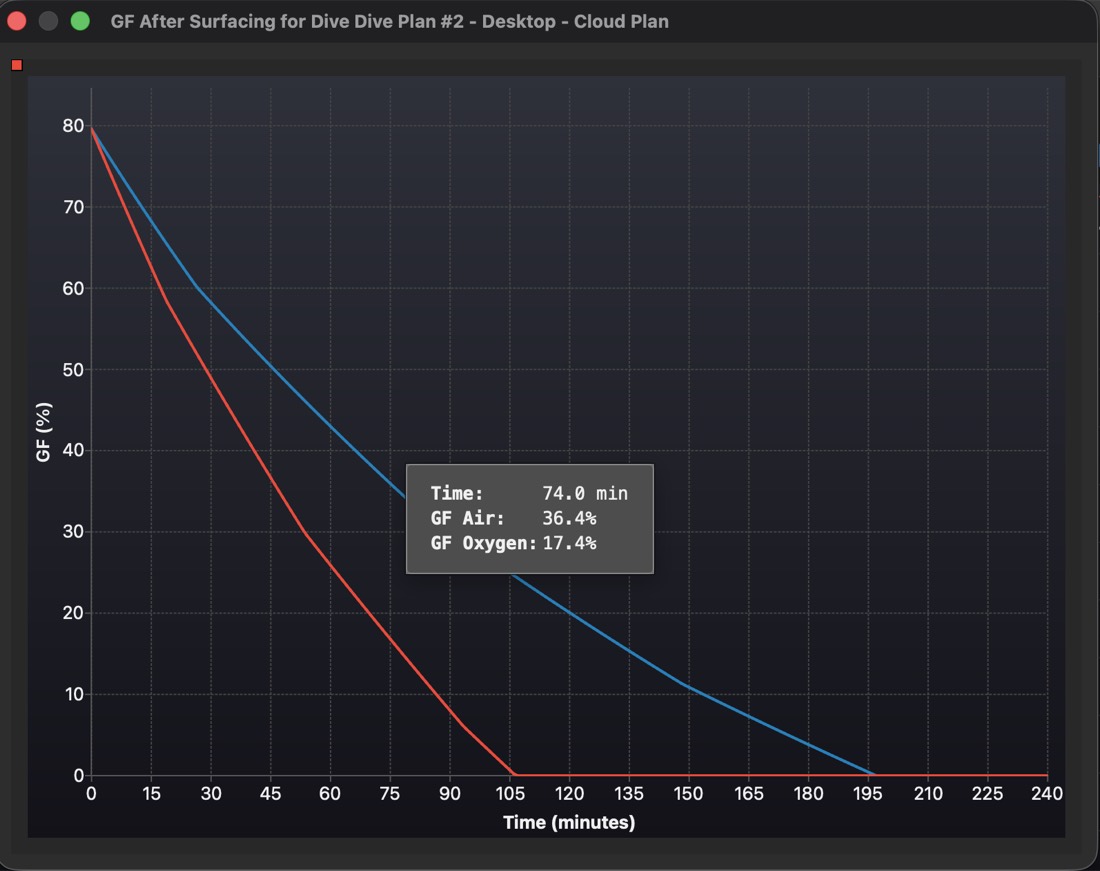
DiveCast plots GF-on-air against GF-on-oxygen decay after surfacing, so no-fly time is a number you read off a graph.
Know when you can fly. Know when you can dive again.
DiveCast plots your gradient factor decay breathing air versus breathing oxygen, so your no-fly window and your next dive's residual nitrogen are numbers you read off a graph - not a flat rule of thumb.
See it on the homepage →Frequently asked
Is a calculated no-fly time safe to use instead of agency guidelines?
A physics-based calculation is a legitimate, more precise answer to "when is my tissue loading safe at cabin altitude" - but agency guidelines exist for good reasons too, including individual physiological variability the calculation can't see. Dehydration, fatigue, cold, and alcohol all warrant extra conservatism beyond either number.
How does DiveCast calculate my no-fly time?
From your actual dive profile - including consecutive dives, not just the last one - the actual cabin pressure of the aircraft you're flying on, and your target gradient factor. Instead of assuming a generic worst case, you enter the specifics of your situation and get a number for that situation.
Does breathing oxygen after diving actually shorten no-fly time?
Yes - oxygen breathing accelerates nitrogen elimination compared to breathing air, which is why comparing both curves side by side is more useful than a single air-only estimate.